A burst pipe or a failed hose
Shut off the main water valve, make the power safe, photograph the damage and call your insurer. Triple-I says burst pipes are typically covered by homeowners and renters policies.1 Wet materials should be dry within 24 to 48 hours.2
Free service. Call now and we'll connect you with a local restoration company. How it works
Right now
Four steps
- 01
Stop the water where it starts
Turn off the main water shutoff; knowing where it is lets you stop a failed hose or pipe quickly.1 If the water is coming from the swamp cooler, a sticking float valve can keep water running until it overflows the tray.3 If monsoon rain is coming through the roof, a tarp is a reasonable temporary repair. Keep the receipt.4
- 02
Make it safe before you save anything
If there is standing water and you can reach the main power switch from a dry spot, turn the power off. If you would have to step into the water to get to it, call an electrician instead. Never touch switches, tools or appliances while standing in water.5 If you smell gas, get everyone outside and call the gas company or the fire department from there.5
- 03
Photograph and film it first
Take photos or video of the damage before you move or throw anything out, and keep damaged items until the adjuster has seen them.4
- 04
Start drying what you safely can
Open windows and doors when the weather allows and run fans and dehumidifiers; the CDC says to point fans so they blow air outward.5 The EPA's target is to dry wet materials within 24 to 48 hours.2 If the heating or cooling system may have got wet, do not run it until it has been checked.2,5
Where it usually fails
Triple-I's advice is to check the hoses on water heaters, dishwashers and washing machines every year, replace any with cracks or leaks immediately, and replace them all every five to seven years. When you go away, shut off the water supply to the washing machine.1
Winter nights still matter
Tucson is not a freeze town most of the year, but Triple-I's advice still applies: turn off and drain outside faucets to protect against frozen pipes.1 The University of Arizona guide also says to disconnect a swamp cooler's water line and blow it out before winter.3
Insurance
Burst pipes are typically covered under homeowners and renters policies, according to Triple-I.1 Photograph first, keep damaged items, call your insurer, and keep receipts for temporary repairs.4 See the insurance guide for the order of steps.
Before you let anyone in
Five questions for whoever answers
- Their Arizona ROC license number. Look it up on the Registrar's site: Arizona law makes it unlawful to contract, or to claim to be a contractor, without a license in good standing unless an exemption applies.6
- Which license covers the work they propose. We did not find a state source that settles whether drying-only work needs a license in Arizona, so ask them and check the answer with the Registrar.
- What water category they have assigned, and what they found that led to it.7
- A written, line-item estimate before work starts.4
- Whether they will talk to your insurer. Tell your insurer yourself before you authorize permanent repairs.4
How this works
What happens when you call
It is free to call, and calling commits you to nothing.
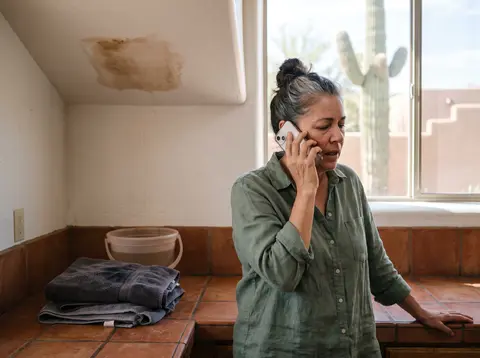
![A woman on the phone in her kitchen, wet towels and a bucket on the counter under a stained ceiling, a saguaro outside the window.]() 1
You call
Tell them what happened and where. Have the address ready.
- 2
We connect you
A call network puts you through to an independent local restoration company that serves Tucson and is taking calls.
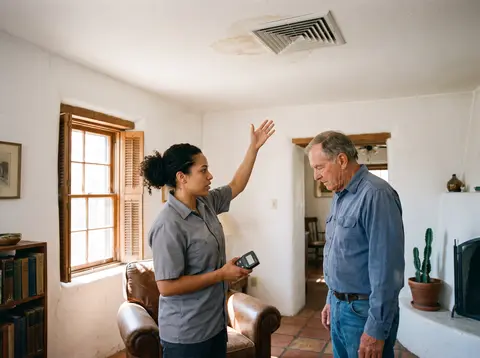
![A technician points to a water stain beside a ceiling vent while a homeowner listens.]() 3
They assess and quote
If you want a visit, they look at the damage and quote their own price. Ask for it in writing.
We are a free referral service, not a contractor. The company that answers sets its own prices. How this service works
Want a local company to look at it?
Free to call. An independent restoration company that serves Tucson answers, and you decide what happens next.
Call (520) 795-0505Tucson Water Damage Advice is a free referral and information service, not a contractor. Calls are answered by independent local restoration companies through a pay-per-call network, and we may be paid when a call qualifies. We do not do the work and do not set prices or availability. How it works
Sources
Each numbered note on this page points here. We read every page on October 24, 2026. Where sources disagree we say so; where we could not find a source we left the claim out. We are not affiliated with any of these organizations.
- Triple-I (Insurance Information Institute), How to protect your home from water damage. No date shown (page copyright 2026). www.iii.org/article/how-to-protect-your-home-from-water-damage
- U.S. EPA, A Brief Guide to Mold, Moisture and Your Home. Page updated February 18, 2026. www.epa.gov/mold/brief-guide-mold-moisture-and-your-home
- University of Arizona Cooperative Extension (Water Wise), Swamp cooler maintenance. No date shown (page copyright 2026). extension.arizona.edu/programs/cochise-county-water-wise/water-saving-tips
- Triple-I (Insurance Information Institute), Settling insurance claims after a disaster. No date shown (page copyright 2026). www.iii.org/article/settling-insurance-claims-after-a-disaster
- CDC, Safety Guidelines: Reentering Your Flooded Home. Page updated August 24, 2026. www.cdc.gov/floods/safety/reentering-your-flooded-home-safety.html
- Arizona Legislature, A.R.S. 32-1151, Engaging in contracting without license prohibited. Current text on azleg.gov. www.azleg.gov/ars/32/01151.htm
- IICRC, ANSI/IICRC S500 Consensus Body Issues Position Statement on Category of Water Damage and Weather-Related Events (press release). March 16, 2026. iicrc.org/wp-content/uploads/2026/04/Weather-Related-Water-Damage-Position-PR_March-2026.p…